

Multilingualism in Research Partnerships and Diversity of Knowledge Systems
November, 2025
By Kristina Pelikan and Jakob Zinsstag (SwissTPH and University of Basel)
We are all multilingual
Communication in research partnerships is always multilingual, as all participants communicate in multiple languages.

In addition to multilingualism between individual languages (e.g. English, Spanish, German), there is also what is known as intralingual multilingualism, i.e. multilingualism within individual languages – for example: dialects (variety peculiar to a specific region), sociolects (variety used by particular social groups, e.g. age, occupation, gender, ethnicity) and also technical languages.
In addition, every person has their own idiolect, based on terms from their personal culture, education, environment, etc. Idiolect is a variety unique to one single person.
Language as a representation of knowledge systems
Language is more than a means of communication, it is a reflection of world views. Every language contains clues in its structures, concepts and metaphors as to how a community understands the world.
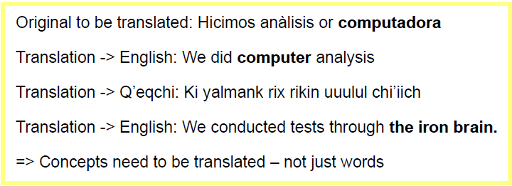
This example from a transdisciplinary workshop involving the Maya community shows that the concept of a computer does not exist in the Maya world view. In order to translate the term “computer”, it was paraphrased as “iron brain”.
At the same time, however, language also influences thinking and directs attention to certain aspects of the world. Languages encode knowledge in different ways – that is, how things are named, categorised and explained. Knowledge is stored in narratives, names and rituals, not in abstract conceptual systems (Zinsstag et al, 2023).
- Indigenous languages often contain detailed ecological knowledge: plants, animals, seasons, relationships between living beings.
- Scientific language is often analytical, abstract and universalising – it separates the observer from the object.
- Religious or mythical languages structure knowledge about the world symbolically, through metaphors and stories.
Strategic use of multilingualism in research collaboration
A common language can be a barrier to realizing the epistemic potential of different epistemic cultures, which is the very purpose for dealing with real-life problems in research. It is therefore advisable to use multilingualism strategically.
What does this mean for collaboration in research partnerships?
- Address multilingualism at the outset and implement it strategically (for example, interviews for data collection in local languages, epistemic writing in the mother tongue, with subsequent translation of the results into the lingua franca, if necessary).
- Reflect on your own identity and clarify the concepts used.
- Discuss how to deal with other people's concepts (in translations, concepts are translated, not words).
Literature:

Using One Health, the SwissTPH Unit Human and Animal Health works on the control of zoonoses and the improvement of the health of different population groups. The unite demonstrates the synergistic potential of closer collaboration between the human and animal health sectors, including with other disciplines and areas of practice. Particular attention is paid to the added value of One Health for improved health and well-being, environmental services and financial savings. Among neglected zoonoses in developing countries, brucellosis and rabies are the focus of our work, which ranges from capacity building to interventions.